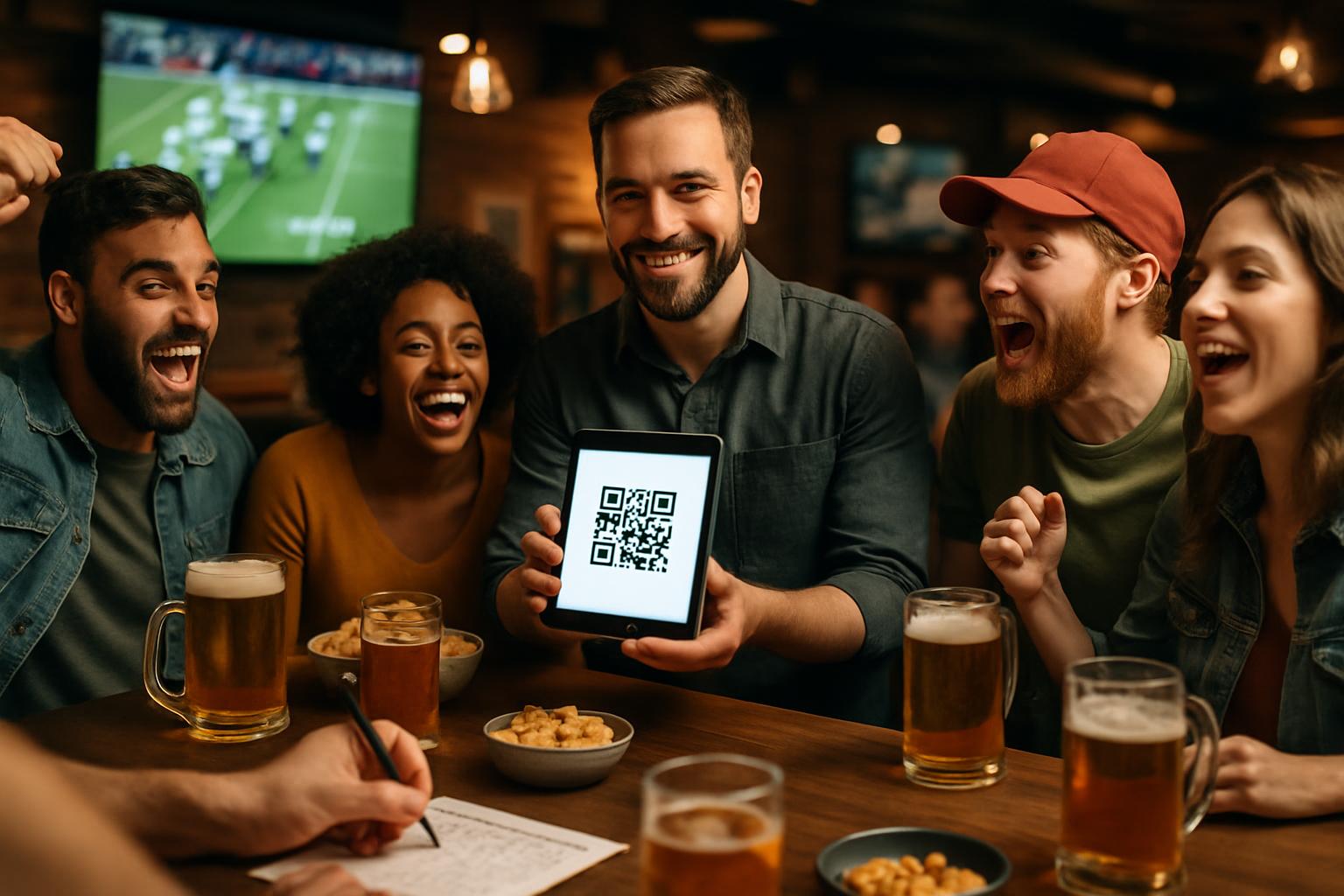
You already have the TVs. You already have the wings and the beer specials. But on any given Sunday, the sports bar down the street has the same setup. What you don't have yet is a reason for a group of twelve people to show up at 11 AM, stake out a table, and not leave until the 4 o'clock game ends.
Football squares is that reason. Not because it's complicated or flashy, but because it turns a passive viewing experience into something people have a stake in. Every scoring play becomes a moment. The couple who got the 7-4 square won't be checking their phones during the third quarter. And they'll definitely be back next week to see if their numbers hit again.
This guide is for venue owners who want to run squares the right way: low friction, legally clean, and structured for repeat foot traffic rather than a one-time gimmick.
Why Squares Work Better Than Other Game-Day Promotions
Most bar promotions are passive. A drink special doesn't make someone cheer louder or stay longer. Score prediction contests have a winner and then they're over.
Squares are different because the format creates ongoing suspense throughout the game. Every quarter, somebody wins. That means four separate moments where someone at a table is either pumping their fist or groaning, and everyone around them knows exactly why. It's social. It's loud. It generates word of mouth in a way that "free appetizer with purchase" never will.
It also scales beautifully for a venue setting. A 100-square board can cover an entire restaurant. Customers pay a small entry fee (or get squares free with a qualifying order), numbers are assigned randomly, and nobody needs to understand spread betting or fantasy scoring to participate. For a full breakdown of how the game mechanics work, the beginner's guide to football squares covers everything your staff would need to explain to a first-timer.
Free vs. Paid Entry: Choosing Your Model
Before anything else, check your local ordinances. In most states, running a paid-entry prize contest at a licensed establishment requires specific permissions, and rules vary. That said, there are two clean approaches most venues use:
The free-entry model gives squares away with a purchase or just for showing up. You fund the prizes yourself (a tab credit, a gift card, a free appetizer). The prize pool is controlled, there's no legal gray area, and it functions as a marketing cost with a clear return: customers who feel like they're winning something spend more and stay longer.
The paid entry model (typically $1-$5 per square) creates a peer-funded prize pool. The crowd self-funds the winners, and your job is just running it well. If you go this route, get comfortable with your state's social gambling and promotional gaming rules first. Many venues run this successfully under a "friendly game among patrons" classification, but that's a call for your attorney or local gaming authority, not your bar manager.
Either way, PickMySquare is free to use. The platform doesn't process the money; that stays between you and your patrons. You just use it to manage the board.
Setting Up the Board with QR Codes
The single biggest operational win for venue squares is removing the paper. A physical printed grid means someone has to manage it all night, it gets beer spilled on it, and half the bar can't see it. A digital board on PickMySquare solves all of that.
Here's the setup that works best for a bar or restaurant:
Table tents with QR codes. Print small table cards (a 4x6 index card works fine) with a QR code linking directly to your board's URL and one line of copy: "Scan to play squares." Put one on every table before kickoff. The scan rate goes up significantly when there's a clear value prop on the card, so something like "Scan to grab your square, winner gets a free round" outperforms a blank QR every time.
TV overlays or chyrons. If you have the ability to add a lower-third graphic to any of your screens (some venues use their own Apple TV or Fire Stick for non-broadcast content), put the QR code there during pre-game. Even a printed sign taped below the TV works. People look at the screens constantly. That's where your board lives.
The bar itself. A QR code standee at the bar, next to the menus, is usually the highest-conversion placement because that's where people are waiting and their phones are already out.
Once people are on the board, they can see the current score, which quarter it is, and which squares are winning in real time. Your staff doesn't have to field questions. The board handles it.
Running It Weekly: The Retention Play
One-time promotions get one-time foot traffic. What you want is a group of regulars who show up every Sunday because that's where their squares are.
The weekly cadence is simple. Create a new board for each game (or each week's slate), promote it on your social media Thursday or Friday, and let regulars know they can claim their squares starting Saturday. When the same people hit a winning square on Week 4, they're not just customers anymore. You've given them a reason to pick your bar over anywhere else, and it cost you the price of a drink special.
For bigger games, especially playoff matchups and the Super Bowl, you can scale up. Multiple boards for different games, larger prize pools, more signage. The NFL squares every Sunday guide goes deep on structuring a full-season run if you want a blueprint beyond just the big games.
During March Madness, this same approach works for the tournament. PickMySquare supports both March Madness squares and bracket pools, so you can give your crowd multiple ways to have something riding on the college games.
Foot-Traffic ROI: The Math Is Simple
Here's a rough frame for why squares pay off as a venue investment. A group of eight who bought into a squares board has a vested reason to stay through all four quarters instead of leaving at halftime. If each person spends $30 over four hours versus $15 over two, that's an extra $120 from one table, per game, for the cost of one printed QR card and a prize that might be a $25 bar tab.
Multiply that across every table in the room for a full Sunday slate and the numbers get meaningful quickly. Add in the social dynamic (people text friends mid-game to come join) and you start seeing organic walk-in traffic during the second half that you weren't getting before.
The retention angle is the longer play. Regulars who associate your bar with winning (even small wins) come back more often and bring people with them. That's not a marketing theory; it's just how loyalty works in a hospitality context.
Getting Your Staff Ready
You don't need to train your whole team on the rules. You need two or three people who can answer: "What is this?" and "How do I play?"
The short version they can give any customer: "It's a grid, you pick a square, and if the score matches your numbers at the end of any quarter, you win." That's it. The board handles everything else. If a staff member wants to go deeper, the how to run football squares post covers common questions and edge cases.
Sports Bar Football Squares FAQ
Do I need to collect money to run football squares at my bar?
No. You can run a completely free game where squares are given out with purchase or just for showing up, and you fund the prizes yourself. Many venues prefer this because it sidesteps any gambling regulation questions entirely.
Is it legal to run football squares with a paid entry at a bar?
It depends heavily on your state and local ordinances. Some jurisdictions classify small-entry prize games among patrons as social gambling and allow it; others don't. Check with your attorney or local gaming/liquor authority before collecting money from customers.
How do I set up the QR code so customers can join?
Create your board on PickMySquare, then copy the board's URL and drop it into any free QR code generator. Print the code on table cards, tape it below your TVs, or put it on the bar. Customers scan, join, and see their squares immediately.
How many squares should one board have for a bar setting?
A 100-square board (10x10 grid) is the standard and works well for most venues. It's enough capacity for a packed room without requiring everyone to participate. If you have a smaller venue or a slow weeknight game, a 25-square mini board works too.
What sports can I run squares for besides NFL?
Any sport with a scoreboard. PickMySquare boards work for NBA games, college football and basketball, NHL, and more. The platform supports any sport where you're matching score digits at the end of a period or quarter.
How do I handle the prize payout if the winner isn't at the bar when the quarter ends?
Most venues handle this by collecting contact info when someone joins (or requiring physical presence at claim time). A simple house rule posted on your table cards solves it before it becomes a problem. The most common approach is "winner must be present" or "winner has 30 minutes to claim."
Set Up Your First Board in Under Two Minutes
Free to create, free to play, and built for exactly this: a room full of people with something to root for. No app download, no printing, no hassle.
Create Free Board →