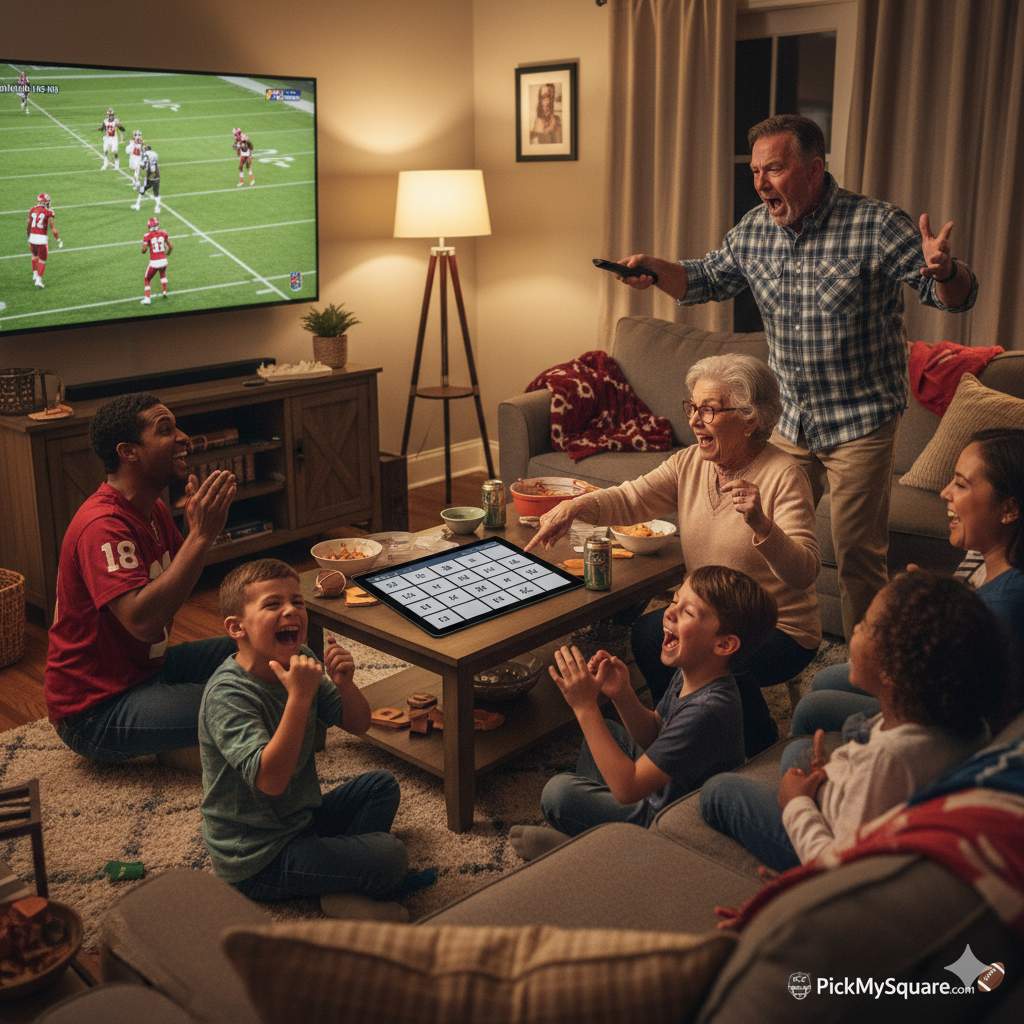
Need a game-night activity that works for the 6-year-old and grandpa at the same time? Football squares is one of the rare games where every age can play, follow along, and actually win. The rules fit in a single sentence, the math is just "last digit," and you get a fresh winner four times during the game so even short attention spans stay engaged.
This guide walks through how to run football squares as a family game-night activity: rules in plain English, age-appropriate variations, a sample script for explaining it to kids, and a five-minute setup that does not turn into a craft project.
Quick takeaway: Open a 10x10 grid. Everyone (including kids) claims a square. After the grid is full, numbers 0 through 9 are randomly assigned to the rows and columns. At each quarter and the final score, the winning square is where the last digit of one team's score meets the last digit of the other. If a kid can read the scores on the screen, they can play.
Why It Works for Families
A few reasons football squares lands for mixed-age groups:
- The rule fits in one sentence. Match the last digit of each team's score. There is nothing else to memorize.
- Four chances to win. Each quarter and the final score produces a winner, so nobody is locked out after one bad bounce.
- Younger kids do not need to read. A 5-year-old can point to "their square" and cheer. Older kids handle the score math.
- Knowing football does not help. A kid who watches with you wins as often as the family member who follows the league.
It is also one of the few activities where toddlers and grandparents can share the same moment. The cheering carries the rest.
What You Need
- A 10x10 grid: paper, a whiteboard, or a free digital board.
- Anywhere from 2 to 100 players (you can leave squares empty; the game still runs).
- A football game on TV.
- Snacks. Optional, but strongly encouraged.
Paper version takes 10 to 15 minutes to set up. Digital version takes about 2.
How Family Football Squares Works (Plain English)
- Draw or open a 10x10 grid. That is 100 squares.
- Decide which team is the rows and which team is the columns. (Or assign after picking, to keep it fair.)
- Each family member claims one or more squares. Kids can pick based on a favorite color, lucky number, or just whichever one looks fun.
- Once squares are claimed, randomly assign 0 through 9 to the rows and to the columns. Pull numbers from a hat or use a random number generator.
- At the end of the 1st quarter, halftime, end of 3rd quarter, and final, the winning square is the one where the last digit of one team's score meets the last digit of the other.
Example: At halftime the score is Chiefs 21, Bills 14. Last digits are 1 and 4. Whoever picked the square at row 1, column 4 wins that checkpoint.
A Sample Script for Explaining It to Kids
If you want a fast way to onboard a 5-to-10-year-old without losing them:
"We have a giant grid with 100 little boxes. Pick one box and write your name in it. When each quarter of the football game ends, we look at the last number of each team's score, like the 7 in 17. We find the box where those two numbers meet on the grid. Whoever wrote their name in that box wins that quarter."
Repeat the rule at the end of the first quarter when you announce the first winner. It clicks fast.
Age-by-Age Tips
Ages 4 to 6. Let them pick by pointing or sticker. Use a 5x5 mini grid if 100 squares feels like too many. Give them a job each quarter: marking the winning square with a sticker, ringing a bell, or being the one who yells "WINNER."
Ages 7 to 10. This is the sweet spot. They can read the scores, do the last-digit math, and announce the winner. Rotate "official caller" between siblings to head off arguments before they start.
Tweens and teens. Hand them the whole board. They can collect names, do the random number assignment, and post the score updates. Give them ownership and they will lean in.
Adults and grandparents. The game is engaging without being demanding. There's no bracket to bust and no spread to track. Just last digits and cheering.
Five Kid-Friendly Variations
- 5x5 mini board. Use 25 squares instead of 100. Faster, easier for small groups, less waiting.
- Sticker squares. Print the grid and let kids decorate their square with stickers, drawings, or team colors before the game starts.
- Snack prizes. Each checkpoint winner gets first dibs at the snack table (a cookie, a soft pretzel, the last slice of pizza). No money, all stakes.
- Bonus halftime guess. Whoever picks closest to the total points at halftime gets a bonus snack or first pick of the remote.
- Family vs. family. If two families are watching together, run two grids and see which side has the most winning squares by the end of the game.
Make Hosting Easy
If you want zero setup time, run the board at PickMySquare.com. You create the grid in two minutes, share a link or QR code (great for cousins on the couch and cousins on FaceTime), and the site randomly assigns 0 through 9 and tracks winners automatically. No erasing, no scoreboard math, no "wait, what was the score at halftime?" The board lives on your phone or the TV. For a step-by-step, see How to Run Football Squares in 10 Minutes (Without the Chaos).
New to the rules entirely? Our Beginner's Guide to Football Squares covers the full setup with examples. Want to give kids a small edge once the numbers are revealed? The Strategy Guide explains which digits show up most often in football scores (hint: 0, 3, and 7).
Family Football Squares FAQ
What age can kids start playing?
Kids as young as 4 or 5 can pick a square and cheer for it. Around age 7, most can read the scores and announce winners on their own.
Do we need to bet money?
No. Plenty of families use snacks, first pick of the remote, a goofy trophy, or just bragging rights. Football squares works as a game on its own.
Can we play without a printer?
Yes. Draw a grid on a sheet of paper, use a whiteboard, or pull up a digital board on your phone or TV. PickMySquare runs in any browser; there is no app to install.
Is this safe for kids who do not like competitive games?
The numbers are random, so no kid is "bad at football squares." Every checkpoint is a fresh chance to win, and a kid who missed the first quarter can still take the final.
Can we use this for non-football games?
Yes. The same grid works for basketball, baseball, soccer, and any sport with a score. For the NCAA tournament specifically, see How March Madness Squares Work.
How many people can play?
Anywhere from 2 to 100. The grid has 100 squares; players can claim more than one if you have a small family. If you do not fill the grid, the game still runs. Empty squares simply stay empty.
The Takeaway
Football squares is one of the few game-day activities where a kindergartner and a grandparent can play the same game and both have a real shot at winning. Set up a grid in five minutes, let everyone pick, and let the last-digit rule do the rest. Keep prizes light, rotate who announces winners, and let the noise level take care of itself.
Set Up Family Game Night in 5 Minutes
Create a free squares board, share the link with the family, and let the site handle numbers and winners. No paper, no chaos.
Create Free Board →