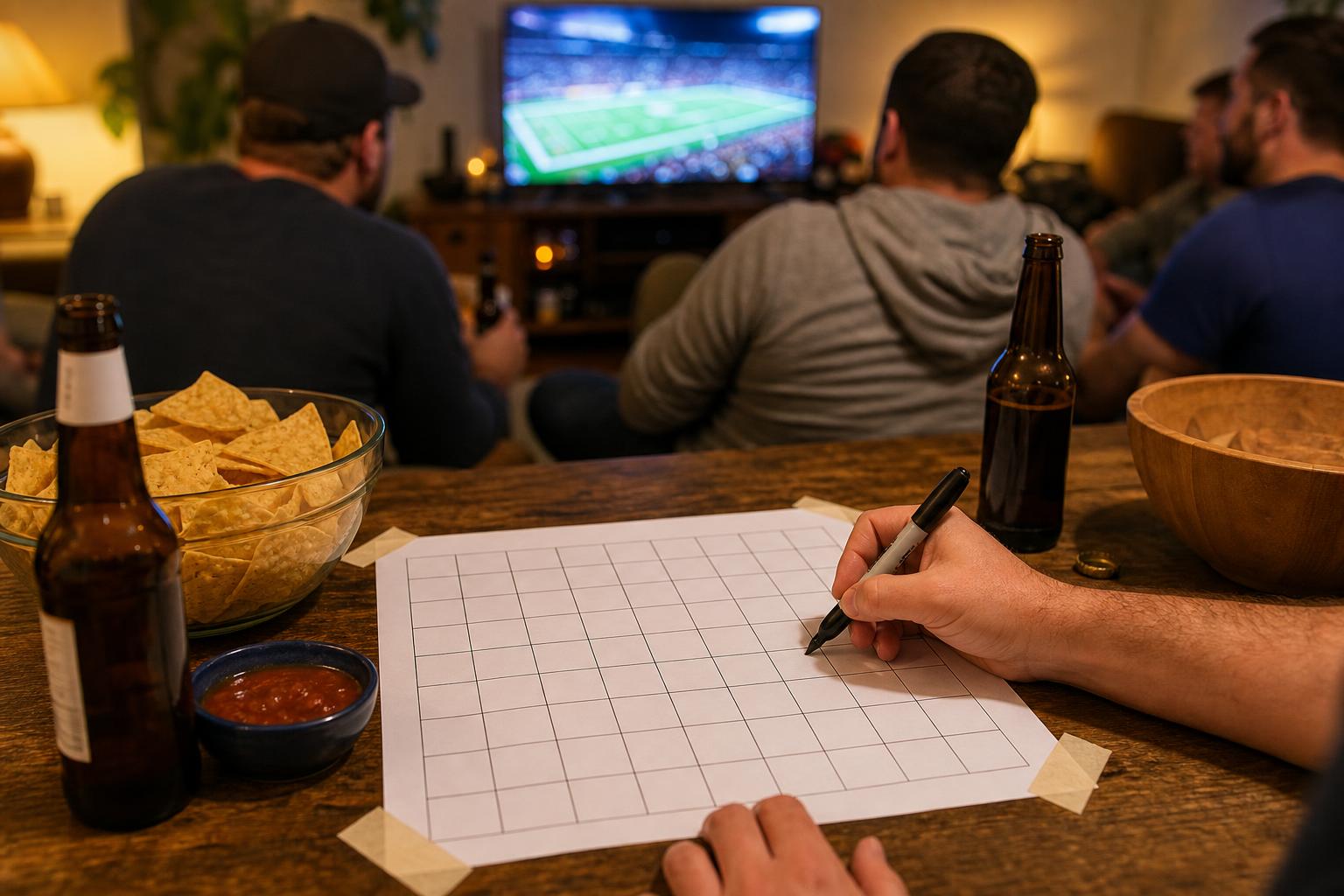
Somebody at work just volunteered you to run the squares pool this year. Maybe it was you, actually, after a couple of drinks watching the playoffs last season. Either way, you're staring at a 10x10 grid wondering how the whole thing works and whether you're about to embarrass yourself in the group chat. Relax. NFL squares is one of the easiest games you'll ever run, and the NFL squares rules fit on a napkin.
Preseason is here (the Hall of Fame Game already kicked things off, the first full preseason slate hits this week, and Week 1 lands in early September), which makes right now the perfect time to learn this before your friends start asking. Let me walk you through it.
What NFL squares actually is
You've got a grid. Ten squares across, ten squares down, a hundred squares total. One team gets the columns, the other team gets the rows. Before the game, every square is blank and up for grabs.
People claim squares by writing their name (or their initials) inside them. Once the grid is full, or once you hit your sign-up deadline, you assign the numbers 0 through 9 to the rows and the columns. Those numbers get shuffled randomly. Nobody knows which numbers they're getting until after they've already picked their squares, and that randomness is the whole point. It keeps things fair.
Then you play the game. At the end of each quarter, you look at the last digit of each team's score. Match those two digits to the grid, find the square where they intersect, and whoever's name is in that square wins that quarter.
That's it. That's the game. No skill, no fantasy-style research, no lineup decisions. If you can find a number on a grid, you can play.
How the numbers work (the part that confuses people)
This trips up first-timers, so here's the slow version.
Say the columns belong to the Chiefs and the rows belong to the Bills. End of the first quarter, the score is Chiefs 14, Bills 7. You ignore the tens digit. The Chiefs have 14, so you care about the 4. The Bills have 7, so you care about the 7.
Now find the Chiefs' column labeled 4 and the Bills' row labeled 7. Trace them until they meet. Whoever owns that one square just won the first quarter. Simple as that.
Do it again after the second quarter (halftime), again after the third, and again after the final whistle. Four scoring checkpoints, four winners. Some hosts weight the final score heavier since it's the hardest to predict, but the basic version splits things evenly across all four.
Setting it up as the host
Here's your job list, start to finish.
Pick your game. Any NFL game works. A random Week 3 Sunday, a Thursday nighter, the Super Bowl, whatever your crew cares about. Bigger games mean more scoring and more excitement per square.
Decide what's on the line. Plenty of pools run totally free, just for bragging rights and a spot in the group chat hall of fame. Others treat it like a snack pool where everyone chips in and the winners grab coffee or pizza. Keep it low and casual if it's your first time. We keep money and prize talk off our platform entirely, so if your group is pitching in anything, sort that part out among yourselves offline and keep it friendly.
Get people to claim squares. Share the grid, let everyone grab as many squares as they want, and set a deadline. This used to mean a paper grid taped to the break room fridge and a lot of chasing people down (if your crew genuinely prefers paper, grab a free printable grid). Now you just send a link. Our how to run football squares guide covers the logistics if you want the deep version.
Lock it and randomize the numbers. Once you're full or the deadline hits, the numbers get assigned. Do this randomly, always, and do it in front of everyone or with a tool that does it automatically. Never hand out numbers before people pick their squares. That's the one rule you cannot bend without people crying foul.
Track the scores and pay out. Watch the game, check the digits each quarter, announce the winners. If you're running it online, this happens on its own.
Common variations you'll run into
Not every squares pool plays it exactly the same, and that's fine. Just decide the rules up front and tell everyone.
Some pools reshuffle the numbers at halftime so the second half is a fresh draw. Some only pay the final score and skip the quarters. Some do a "reverse" or "flip" payout, where if the Chiefs-4, Bills-7 square wins, the Bills-4, Chiefs-7 square also gets a smaller cut. Others let one person own more than a set number of squares, or cap it so no single person hogs the grid.
None of these are the "correct" way. They're flavors. Pick what your group likes and write it down before kickoff so nobody argues later.
Why squares beats a lot of other pools
The best thing about NFL squares is that everybody stays in it. In a survival pool or a fantasy league, half the room is mathematically dead by November and stops caring. Squares doesn't do that. A person with one square in the corner can win the whole thing on a fluke safety, and the person who grabbed ten squares can go home with nothing. That underdog chaos is what makes people scream at their TVs.
It's also friendly to people who don't follow football closely. Your aunt who can't name a single quarterback has the exact same odds as the guy who watches film on weekends. If you've ever tried to explain fantasy to a beginner, you know how valuable that is. We wrote more about that trade-off in football squares vs fantasy, and honestly the simplicity wins more often than people expect.
If you want a full-season plan instead of a one-off, our NFL squares every Sunday guide shows how to keep a board running week after week without it becoming a second job.
A few rookie mistakes to dodge
Don't forget to tell people how many quarters pay out before they claim anything. Don't let one loud person talk you into handing them their "lucky" numbers before the draw. And don't try to track a busy Sunday's worth of scores by hand across four different games if you can let software do it. The most common way a first-time host loses trust is a math error at 11 p.m. when everyone's tired, so take the arithmetic off your plate.
NFL Squares Rules FAQ
Do I need to know football to play squares?
Nope. The numbers are random and the outcome depends on the scores, not on any picks you make. Someone who has never watched a game has the same shot as a die-hard.
How many people do I need?
You can technically run a board with as few as you want, but a full grid is 100 squares. Ten to twenty-five people each grabbing a handful of squares tends to fill it out nicely.
What happens if the grid doesn't fill up completely?
You've got options. You can leave the empty squares as "house" squares that don't pay, extend your deadline, or let people grab extras. Just decide before you randomize the numbers so it's fair.
When do I assign the numbers?
Always after every square is claimed, never before. Assigning numbers first lets people angle for the good digits, and that ruins the whole game.
Which numbers are the best to have?
Historically 0, 3, and 7 show up a lot because of how football scoring works (touchdowns, field goals, extra points). But since the numbers are random, you don't get to choose, so don't lose sleep over it. Our football squares strategy guide breaks down the number odds if you're curious.
Can I run squares for a preseason or Thursday night game?
Absolutely. Any game with a score works, preseason and regular season alike. Smaller games are actually a great low-stakes way to practice hosting before the Super Bowl crowd shows up.
Ready to host your first NFL squares pool?
Set up a free board in about a minute. The grid fills online, the numbers randomize themselves, and the winners get flagged every quarter so you never have to do the math.
Create Free Board →