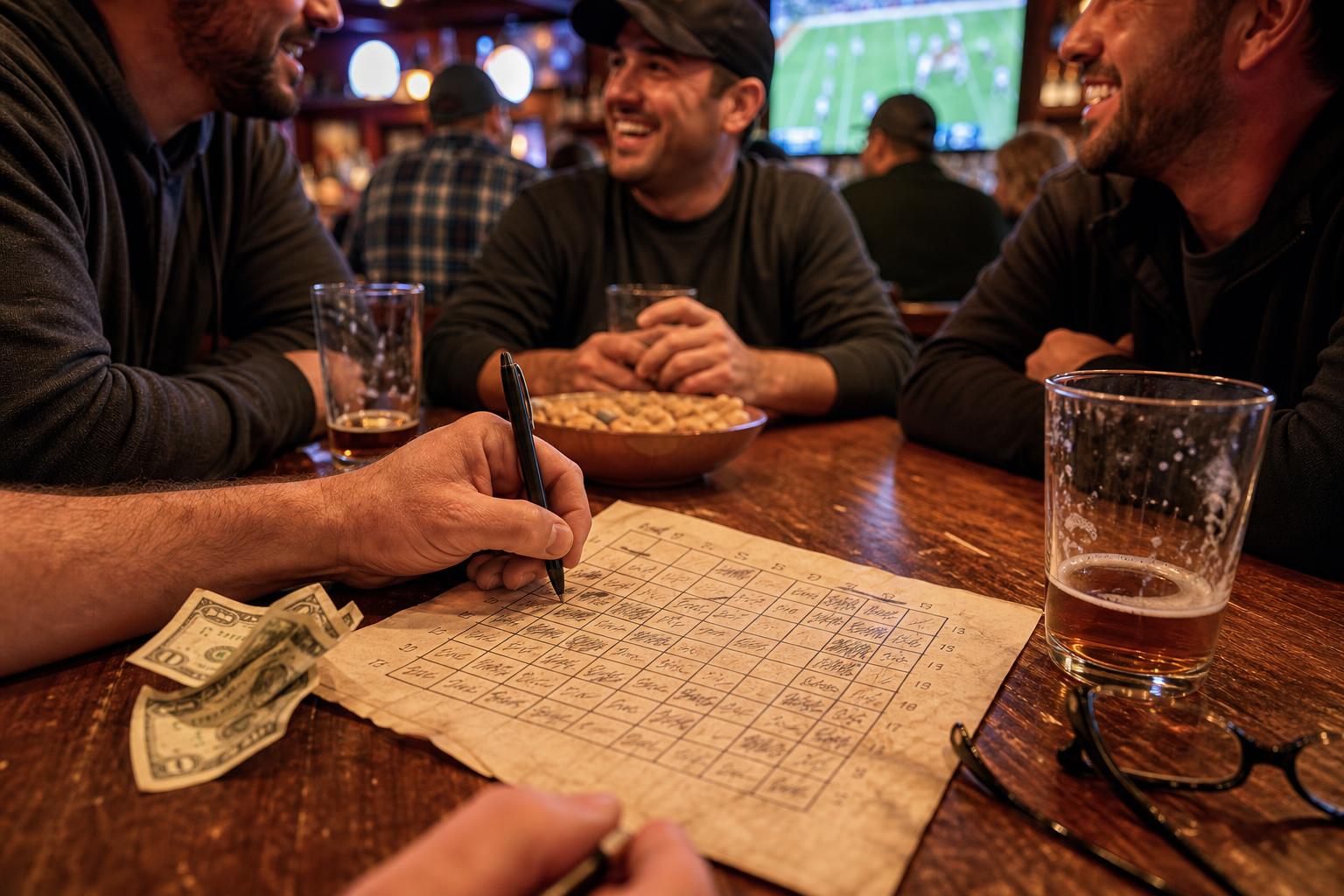
Nobody can point to the person who invented football squares. There's no patent, no origin plaque, no founding legend with a date attached. The game just sort of appeared, spread through offices and living rooms and corner bars, and never left. That's actually the most interesting thing about football squares history: a game with no clear inventor has outlasted a hundred trends that had marketing budgets and launch parties.
So let's talk about where it probably came from, how it actually works, and why a grid of 100 boxes still shows up every football Sunday when almost everything else about how we watch sports has changed.
Where football squares came from
The honest answer: nobody knows exactly. The exact origin isn't documented anywhere reliable, which is what happens with folk games that pass hand to hand instead of getting sold in a box. What we can say is that football squares became widespread in America somewhere around the middle of the 20th century, and it really took off in offices and social clubs through the 1970s and 1980s.
That timing isn't a coincidence. The Super Bowl was turning into a genuine national event during those exact decades. As the game got bigger, more people wanted a way to feel involved, including plenty of folks who didn't care about cover-2 defenses or which quarterback was hot. Squares gave them a stake. You didn't need to know a thing about the teams to have a reason to watch every scoring play.
The setup was almost aggressively low-tech, and that was the point. A pool ran on one sheet of paper, a pen, and whoever was willing to collect from everybody. No app, no rulebook, no gatekeeper. Someone drew a 10 by 10 grid, wrote names in boxes, and the thing basically ran itself. That portability is a big reason it spread the way it did. You could start a pool anywhere there was a football game on and a group of people who wanted in.
How football squares actually works
If you've never run one, here's the whole thing. It really is this simple.
You start with a grid of 100 squares, 10 across and 10 down. One team's name goes along the top, the other team's down the left side. People claim squares, usually just by writing their name in an open box, until all 100 are taken.
Once the grid is full, you assign the numbers 0 through 9 to the columns and 0 through 9 to the rows. And here's the part that makes the whole thing fair: those numbers get assigned randomly, after every square is already claimed. Nobody picks a "good" number, because nobody knows what their number will be when they grab a box. You could take one in the top corner and end up with a 7 and a 0, or a 5 and a 2. It's the luck of the draw, literally. Want to watch the actual draw happen? Our football squares number generator draws 0 through 9 live, one digit at a time.
From there, the score does all the work. At the end of each quarter you look at the last digit of each team's score. Say it's 17 to 10. You take the 7 and the 0, find where those two numbers meet on the grid, and whoever's name is in that box wins that quarter. Four quarters, usually four winners, though hosts split things however they want.
That's it. There's no skill, no strategy during the game, nothing to manage. You claim your square, you get your numbers, and then you just watch. We wrote a full walkthrough in our beginner's guide to football squares if you want the step-by-step with pictures.
The one thing that looks like strategy
People love to argue about the "good" numbers, and there's a kernel of truth to it. Because of how football scoring works, with touchdowns and field goals landing on certain totals over and over, some digits genuinely come up more than others. A 0 or a 7 is worth more over a long enough run than a 2 or a 5.
But here's the catch that keeps the game honest: you get your numbers randomly, and you get them after you've already grabbed your square. So knowing that 0 and 7 are strong doesn't help you claim them. It just gives you something to celebrate or complain about once the draw happens. If you want to go down that rabbit hole anyway, our football squares strategy guide breaks down which digits actually pull their weight and why.
The takeaway is that squares dresses up as a game of chance and stays that way. The "strategy" is fun to talk about and changes nothing, which is exactly why it never ruins anybody's night.
Why it stuck around when so much didn't
Plenty of party games have come and gone. Squares kept going, and I think it comes down to a few things that have nothing to do with football.
First, everybody's equal. The die-hard who watches every snap and the person who showed up for the snacks have the identical odds. That's rare. Most games reward the people who already know the most, which quietly pushes out everybody else. Squares does the opposite. Grandma has the same shot as the guy in the fantasy league, and honestly she wins more often than seems fair.
Second, it fills the dead air. Football has long stretches where nothing's happening, and squares turns every score into a moment where a dozen people check their boxes at once. It gives casual watchers a reason to look up.
Third, and this is the sneaky one, it barely asks anything of you. You claim a square once and you're done. Compare that to fantasy football, which is basically a part-time job from September to January. Both are fun, they just ask for wildly different amounts of your life. We got into that tradeoff in squares vs fantasy, and the short version is that simple wins more often than people expect.
The game also adapts without changing. The rules that worked on a bar napkin in 1978 work on a phone screen in 2026. All we really did at PickMySquare was take the paper-and-pen version, kill the math and the chasing-people-down part, and put it online so the numbers assign themselves and everyone can see the grid update live. The bones are identical. The grid is still a grid.
Squares aren't only a Super Bowl thing
The Super Bowl gets the credit, but squares works for any game with a score. Regular-season Sundays, playoff games, college rivalry weekends, a random Thursday nighter. Any football with a scoreboard is fair game, and a lot of hosts run a fresh board every week during the NFL season just to keep the group chat alive.
It travels beyond football too, since all you need is two teams and a running score. Basketball, hockey, baseball, it all works. The bracket-pool side of what we do is its own separate thing built specifically for the NCAA tournament, and if March is on your mind, our March Madness guide covers both the squares and bracket angles for the big dance.
Football squares history FAQ
Who invented football squares?
No one knows for sure, and there's no reliable record of a single inventor. It spread as a folk game through offices and social gatherings, mostly picking up steam in the 1970s and 1980s as the Super Bowl became a huge deal.
How old is the game of football squares?
It became widespread around the middle of the 20th century, so it's been part of American football culture for well over half a century. The lack of a documented start date is normal for games that passed around by word of mouth instead of being sold commercially.
Why is it called football squares?
Because you play it on a grid of squares tied to a football game's score. It goes by a bunch of names too: Super Bowl squares, the boxes, football pool, or just "the grid," depending on where you grew up.
Is football squares a game of skill or luck?
Almost pure luck. You get your numbers randomly after claiming your square, so there's no way to grab the strong digits on purpose. That's the whole reason it's so friendly to casual fans.
Can you play squares for games other than the Super Bowl?
Absolutely. Any game with a score works, from a regular NFL Sunday to a college bowl game to a hockey or basketball matchup. The Super Bowl just made it famous.
Do you have to play squares for money?
Not at all. Plenty of people run boards for bragging rights, house chores, or just fun. Our family game night post has stakes-free ideas if you want the tradition with nothing on the line.
Start your own square of history
A game this old and this simple should take about two minutes to set up. Draw a fresh grid, invite your group, and let the numbers pick themselves.
Create Free Board →