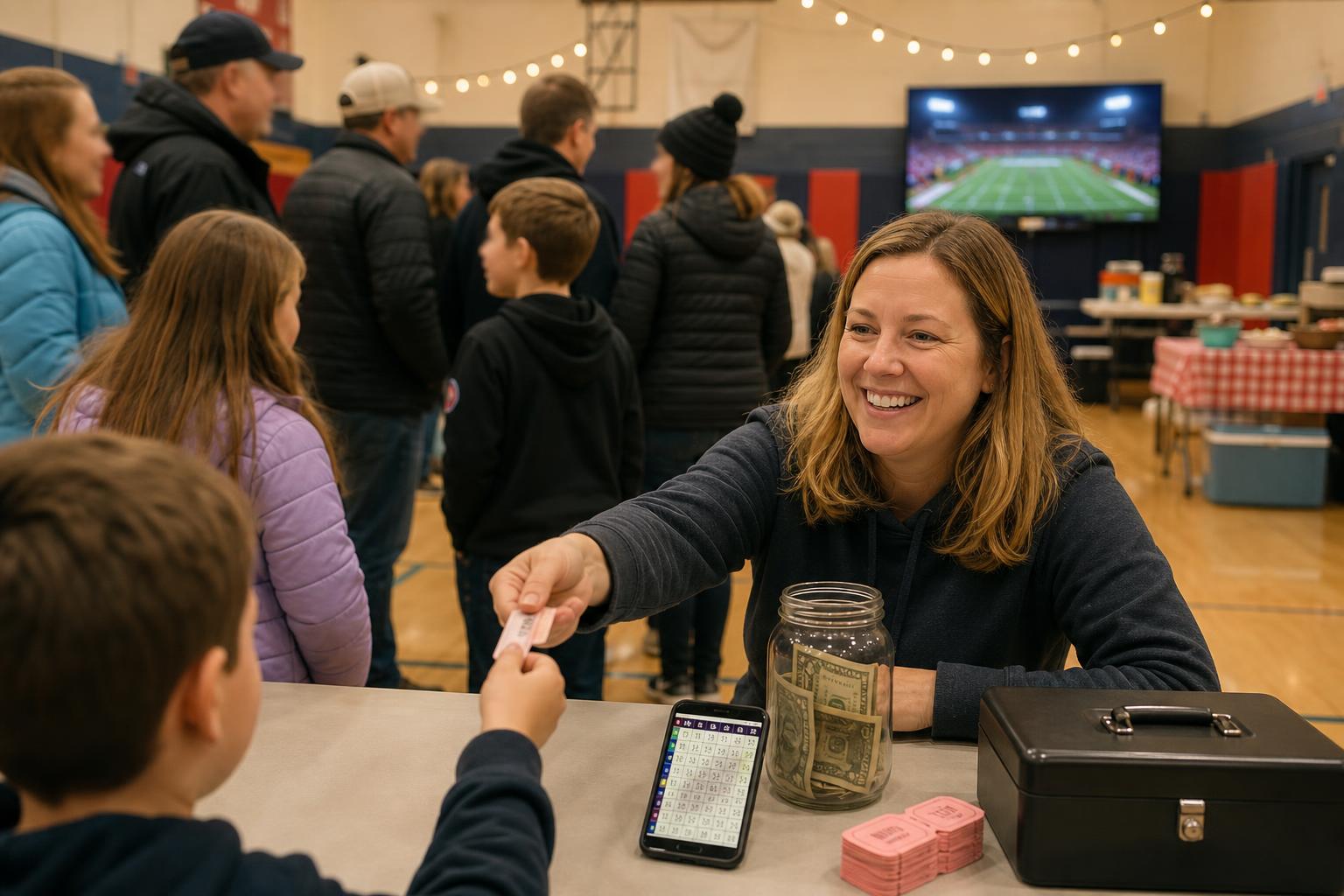
Every booster club treasurer has the same nightmare: you launch a fundraiser, forty people say they're in, and three weeks later the sheet is still half empty. A 100 square raffle fundraiser can absolutely clear four figures for your team or your fire department, but only if you run it like an organizer instead of hoping it fills itself. The grid doesn't sell the squares. You do.
This is the money-and-logistics side of it. If you want the mechanics of how a winner gets drawn on the board, that lives on the raffle board page itself. Here we're talking about the part that decides whether you raise $200 or $2,000: what you charge, how you split the pot, and how you get all 100 names filled before your deadline.
First, the part nobody wants to read: the legal caveat
I'm putting this up top because it changes how you run everything else. A raffle where people pay money for a chance to win a prize is, in most US states, a regulated form of charitable gaming. It fits the legal definition of a lottery, and states treat it that way. Many require a nonprofit to get a permit or license before selling a single ticket, some offer exemptions under a dollar threshold, and a few states (Hawaii, Utah, and Alabama) don't provide a workable charitable-raffle exception at all. Running one without the right paperwork can mean fines or worse for the organization.
I'm not a lawyer and this isn't legal advice. Before you charge anyone, check with your state's charities division or gaming commission, or ask whoever handles compliance for your organization.
Here's the practical workaround a lot of groups use: keep the board free and attach a donated prize. When there's no paid entry, you sidestep most of the gaming-license machinery, because it stops being a raffle in the legal sense. A local business donates the prize, people sign up for a square at no cost, the winner gets the item, and your fundraising happens through the sponsorships and donations around the event instead of through the squares themselves. Plenty of school and youth-sports groups run it exactly this way. Whether it works for your situation depends on your state, so confirm it.
Everything below assumes you've sorted out which model is legal for you.
Setting the price per square
If you are running a paid version legally, the math is refreshingly simple. One hundred squares, one price each, and your gross is just price times how many sell.
- $5 a square tops out at $500 and fills fast. Good for a classroom, a single team, a first-timer testing the waters.
- $10 a square is the sweet spot for most PTA and booster crowds. A full grid is $1,000 and $10 doesn't scare anyone off.
- $20 or $25 works when your list skews toward adults with disposable income (think a company team or a Friday-night booster crowd), but expect it to fill slower.
Don't overthink round numbers. The bigger lever is your list, not your price. A $5 board that fills 100 squares beats a $25 board that stalls at 40 every single time.
50/50 versus a multi-prize structure
Two ways to split the take, and they pull different crowds.
The 50/50 is the classic: half the money goes to the cause, half goes to the winner. On a full $10 board that's $500 to your team and a $500 payout. It's clean, everyone understands it instantly, and the big number does your marketing for you. The downside is you only create one winner, so casual folks who assume they'll never win sometimes don't bother.
A multi-prize structure spreads the payout across the game. Pay out every quarter, or run first/second/third prizes, so more people have a rooting interest and stay engaged. You might do 40% to the cause and split the other 60% across four quarter winners. It raises a hair less per board but it keeps the group buzzing all day, which matters if this is tied to a game-watch event where the fundraiser is the entertainment.
My take: 50/50 for a pure fundraiser where the goal is a big check, multi-prize when the squares are the party. Pick based on the room, not the spreadsheet.
Hitting a deadline so the grid actually fills
This is where most fundraisers die. Without a hard close date, squares trickle in until nobody remembers the thing exists.
Set the deadline before the game and say it out loud, repeatedly. Then work backward. Announce it, remind at the halfway mark, and hit people again 48 hours out with a real number: "18 squares left, closes Thursday." Scarcity fills the last row faster than any launch post ever will. A shared board link that shows the empty spots shrinking in front of everyone does a lot of this work for you, because people can see how close it is to full.
If you've never run one of these start to finish, our guide to running football squares walks through the timing rhythm in more detail.
Handling the squares that don't sell
Some boards fill to 100 and some stall at 78. Have a plan for the gap before it happens.
The cleanest option is to have the organizing group cover the leftovers as its own contribution, which guarantees a full grid and a full payout. If that's too rich, adjust the prize to what actually sold: on a 50/50, the payout is just half of collected money, not half of a theoretical full board. Say that up front so nobody expects a $500 prize off a $780 board. A few groups leave unsold squares empty and simply have no winner if the number lands there, but that stings, and I'd avoid it. Better to close the board smaller than to leave dead squares on the grid.
Collecting the money (organizer-side, always)
One thing to be clear about, because it trips people up: PickMySquare never touches your money. The board is the free organizing tool. It tracks who has which square and updates in real time. Every dollar of collection and every payout happens on your end, exactly the way it always has for a fundraiser. Venmo, cash in an envelope, a check to the booster account, whatever your treasurer already uses.
That's a feature, not a limitation. It keeps you out of payment-processing fees and keeps the funds flowing straight to the cause instead of through a middleman. Assign one person to reconcile the list against payments received, and mark squares as paid as they come in so you're not chasing anyone the morning of the game. If a business is sponsoring squares in exchange for a logo on the board, treat that as a normal sponsorship conversation and get the commitment in writing.
Why 100 squares and why online
The 10x10 grid is the format because everyone already gets it and the math never breaks: 100 squares, 100 chances, done. Running it on a free online board instead of a paper printout means no lost sheets, no arguing over handwriting, and everyone can follow along from their phone. If you're weighing this against a bracket pool or a fantasy-style setup, squares wins for fundraisers precisely because it's this simple. We made the full case for that here.
Squares also aren't just a football thing. The same 100-square board works for any game with a score, so a booster club can run one every home game across the season, not only on Super Bowl weekend. The beginner's guide covers the basics if anyone on your committee is new to it.
100 Square Raffle Fundraiser FAQ
Is a paid 100 square raffle legal?
In many states a paid-entry raffle counts as regulated charitable gaming and needs a permit, and a few states don't provide a workable charitable-raffle exception at all. Rules vary a lot, so check with your state's charities or gaming office before you charge anyone. A free board with a donated prize sidesteps most of that, but confirm it for your state.
How much can a 100 square fundraiser raise?
On a full $10 board, $1,000 gross. Split 50/50 and your cause keeps $500. Bump the price to $20 or run it every home game across a season and the totals climb from there.
What's better, 50/50 or multiple prizes?
50/50 if the goal is one big check and simple marketing. Multiple prizes (or quarter payouts) if the squares are the entertainment at a watch party and you want to keep people engaged all game.
Does PickMySquare handle the payments?
No. The board is a free organizing tool. All collection and payouts happen on the organizer's side through whatever method you already use. We never process entry fees or prizes.
What if we don't sell all 100 squares?
Either have the group cover the leftovers to keep a full grid, or size the prize to what actually sold. On a 50/50 the payout is half of the money collected, not half of a full board. Say which one up front.
Can we run this for something other than football?
Yes. The 100-square board works for any game with a score, so basketball, baseball, or a season of home games all work the same way.
Ready to fill all 100 squares?
Spin up a free raffle board in a couple of minutes, share the link, and watch the grid fill while your treasurer handles the money. No fees, no processing, no lost paper sheets.
Create Free Board →