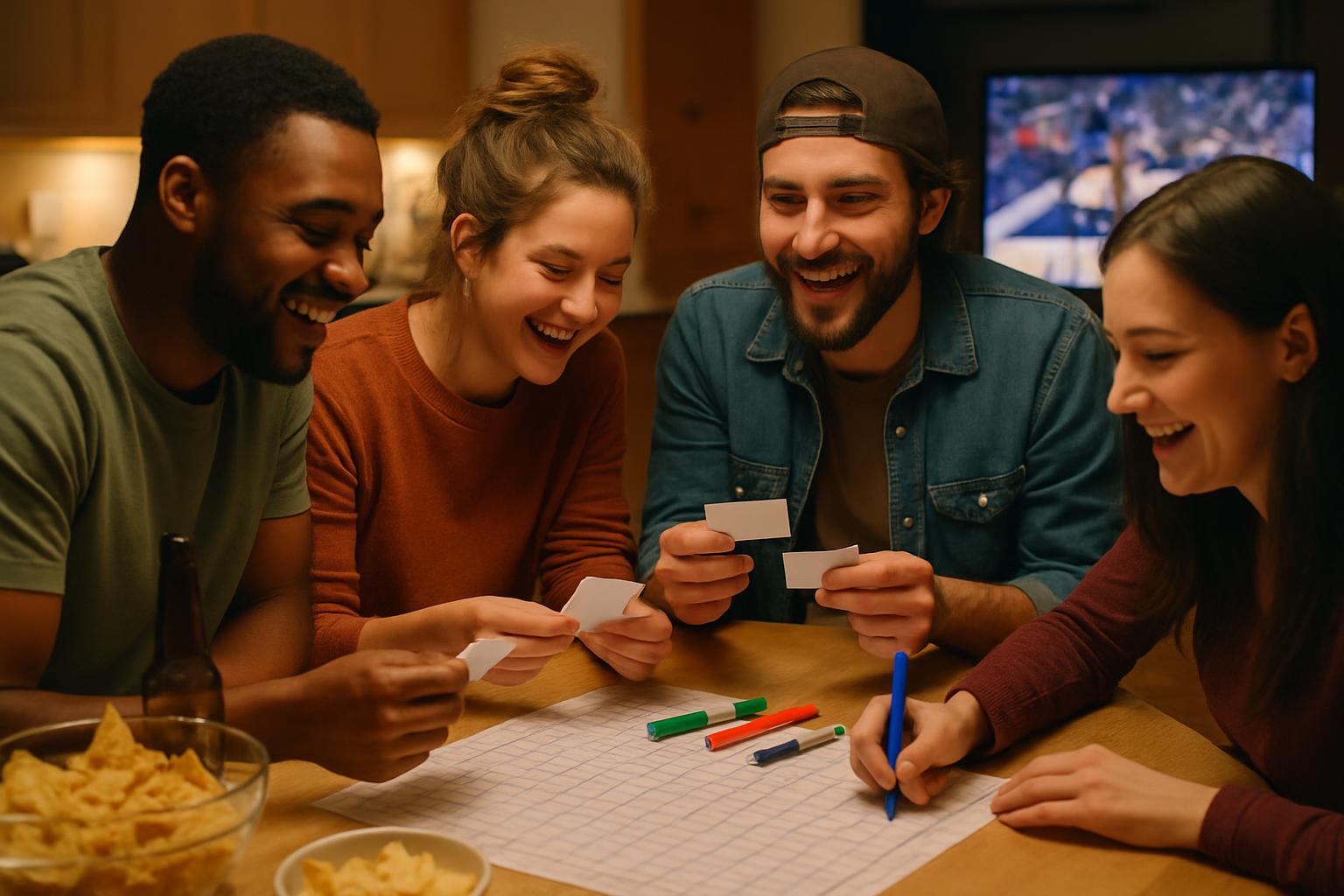
The Knicks and Spurs are in the NBA Finals right now, with the Knicks leading 2-1 with Game 4 on deck, and there is no better excuse to get a squares board going with your friends. If you've ever thought squares were a football-only thing, you've been leaving free entertainment on the table all season.
Basketball squares work exactly the same way as the Super Bowl version, and they're just as fun to play. Here's everything you need to run one, whether you're hosting a watch party for Game 4 or just want something to make the next regular-season matchup matter a little more.
The Basic Idea (Quick Version)
A squares board is a 10x10 grid, giving you 100 cells. Each cell gets assigned a number from 0-9 along the top (one team's digits) and a number from 0-9 down the side (the other team's digits). Players claim cells before the numbers are randomly assigned, so nobody knows which squares are good until the numbers are drawn.
You win when the last digit of each team's score matches your square's coordinates. In basketball, that typically happens at the end of each quarter, which means four chances to win during a single game instead of just one.
If you've played football squares before, this is the exact same thing. And if you haven't, the beginner's guide to football squares walks through the full mechanics in plain language.
Setting Up a Basketball Squares Board
Step 1: Choose your teams and your grid
Label the top row with one team and the left column with the other. For the NBA Finals, you'd put Knicks across the top and Spurs down the side (or flip it, doesn't matter). For a college game, same idea.
Step 2: Sell or assign the squares
Players pick their cells before the numbers go up. Charge whatever fits your group: $1 a square, $5, $10. With 100 squares and $5 each, you've got a $500 pot to split up however you want.
Step 3: Randomly assign the numbers
Once all (or most) squares are claimed, draw the digits 0-9 randomly for each axis. You can write them on slips of paper and pull them out of a hat, or use PickMySquare, which does the random draw automatically and shows everyone the board instantly.
Step 4: Watch the game and pay out winners
Check the score at the end of each quarter. Find the last digit of each team's score, trace the column and row to where they meet, and whoever owns that square wins that payout. Four quarters, four winners. Simple.
Payout Structures That Work for Basketball
The most popular setup splits the pot evenly across quarters: 25% per quarter. Clean and easy to explain.
But you can mix it up. Some groups weight the final score higher because it's the most dramatic moment:
- Q1: 20%
- Q2: 20%
- Q3: 20%
- Final: 40%
Another option is to run a separate mini-pot for halftime and keep the main payouts at Q1, Q3, and Final. Works especially well for big games like the Finals where people want more action.
There's no right answer. Pick a structure your group agrees on before the game starts and write it down somewhere everyone can see.
Why Basketball Is Actually Great for Squares
Football squares are famous because of the Super Bowl, but basketball arguably has a better setup for this format. Here's why.
Basketball scores are higher and end in more varied digits. In football, you're hoping for a 0, 3, or 7 because scoring events cluster around those numbers. In basketball, a team could end a quarter on any digit from 0-9 with roughly similar frequency. That flattens the value difference between squares and makes every cell more competitive.
You also get more scoring events per game. Final scores in NBA games often land in the 100s, which means digit variety on both axes. Compare that to a 10-7 football game where two people with zeros and sevens split everything.
And four payouts per game keeps people watching all the way through. Nobody checks out at halftime because their square already lost. The Q3 payout alone pulls people back in after the break.
Running Squares for Different Basketball Formats
NBA Playoffs / Finals: The current Knicks-Spurs series is a perfect fit. Run a fresh board for each game, or if your group is small, run one board across the whole series by assigning a payout for each game's final score.
March Madness games: This is where things get really fun. You can run a squares board alongside a bracket pool and give people two separate ways to win. The bracket rewards knowing your teams; the squares board rewards nothing at all, which is why your aunt who doesn't watch basketball is always in contention. Check out our March Madness bracket pool guide if you want to run both at once.
Regular season games: There's no rule that says squares only count for big games. A random Tuesday night game between middling teams becomes significantly more interesting when everyone has something riding on it. Run a low-stakes board with dollar squares and suddenly everyone in the group chat is watching a Pacers game in February.
Watch parties: Squares are one of the best watch party games because the barrier to entry is zero. You don't need to know anything about basketball to play. You just need a square.
Common Mistakes to Avoid
Assigning numbers before all squares are claimed. Once the numbers are up, late buyers know which squares are valuable. Assign numbers last, always.
Not deciding on payouts in advance. "We will figure it out after" always creates a dispute. Write the payout rules down before anyone locks in their squares.
Running it on paper and losing track. A photo of a hand-drawn grid on a folded napkin is going to cause arguments. Using a digital board where everyone can see their squares in real time cuts that problem completely.
Forgetting to communicate the results. Half your players are watching the game on delay or checking their phone. Send the score updates out. Group chats work fine. PickMySquare shows the live grid so anyone can check it themselves.
For a deeper look at running these for a larger group or a fundraiser, the football squares how-to guide covers pool management, collecting money, and keeping things organized, and it all applies to basketball boards too.
Basketball Squares FAQ
How many quarters do you pay out in basketball squares?
Standard is four payouts, one at the end of each quarter. Some groups add a halftime payout as a fifth prize, especially for longer playoff games.
What score combinations win the most in basketball squares?
The distribution is fairly even across all ten digits, which is what makes basketball squares more competitive than football squares -- there's no 0, 3, or 7 equivalent that dramatically outperforms the rest.
Can you run basketball squares online for free?
Yes. PickMySquare is free to use. You set up the board, share the link, and players claim their squares from their phones. The site handles the random number draw and shows the live grid.
Do basketball squares work for college games?
Absolutely. NCAA games run four 10-minute quarters (women's) or two 20-minute halves (men's), but you can pay out at halftime and the final in the men's game, or stick to the standard four-quarter payout for the women's game.
What is the best square size for a small group?
A standard 10x10 board has 100 squares. For a small group where you can't fill that many, you can allow people to buy multiple squares or run a 5x5 board with 25 cells. PickMySquare supports custom grid sizes.
How do you handle a tie at the end of a quarter?
In basketball, ties at the end of regulation lead to overtime, so the final score always resolves. Mid-game ties are irrelevant since you only check the score at the official end of each quarter, not during live play.
Ready to Run Squares for Game 4?
Set up a free basketball squares board in about two minutes. Share the link, let everyone grab their squares, and the random number draw handles itself. Works for the NBA Finals, March Madness, or any game you want to make more interesting.
Create Free Board →