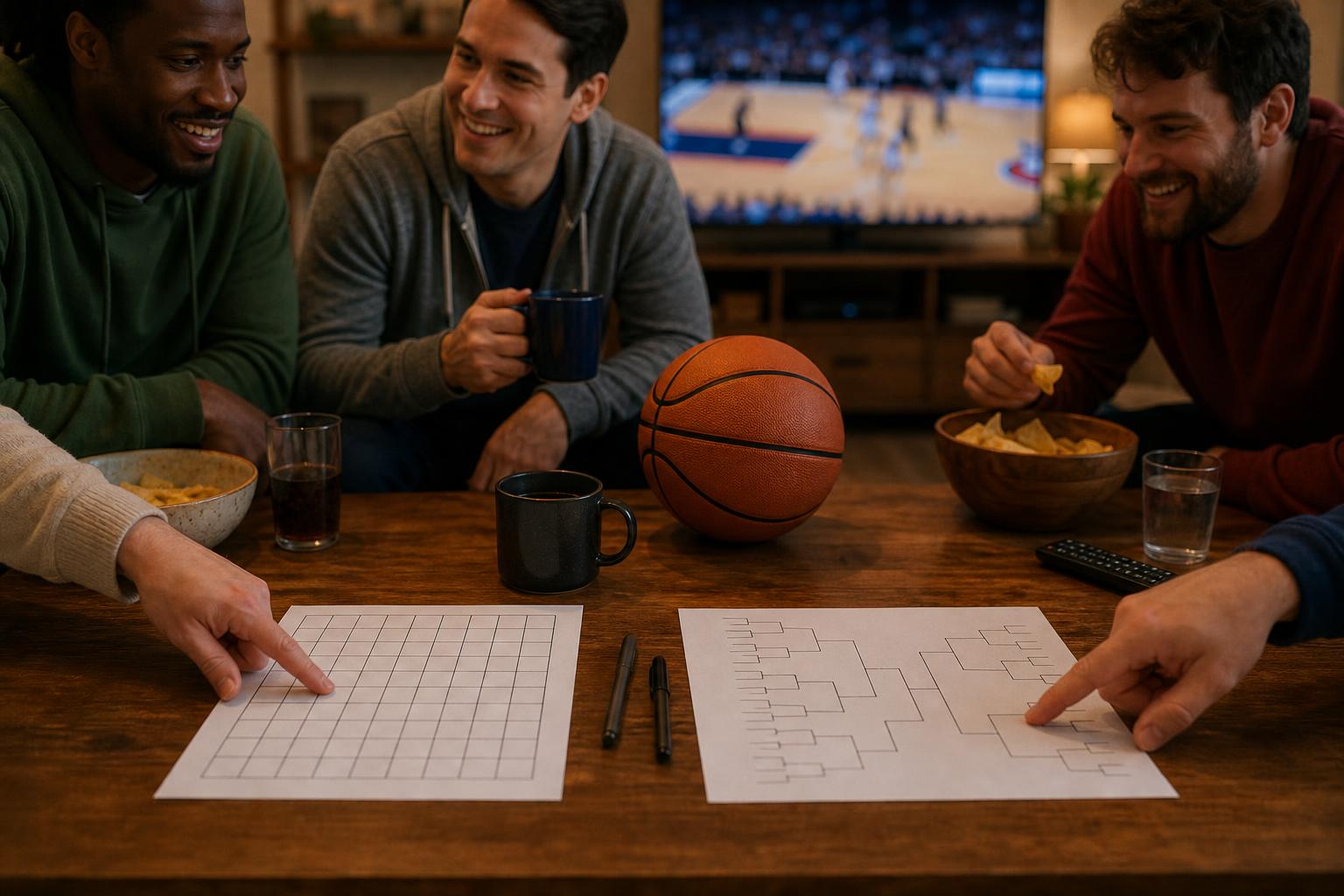
Every March, somebody in your group chat asks the same question: are we doing a bracket this year, or squares? And every year the answer is a little vague, half the people fill out a bracket on three different sites, and the squares board gets organized at the last second on a printed PDF that nobody can read. There's a better way to decide, and it doesn't take much.
The honest answer to the March Madness squares vs bracket pool question is that these two pools do completely different jobs. A bracket pool rewards knowing basketball. A squares board rewards owning the right two digits. Picking between them comes down to who's actually in your group and how much they want to think about it. Let me walk through how I'd choose.
What each one actually does
A bracket pool is the classic. Everybody predicts the whole tournament before it tips off, from the Round of 64 through the title game, and you rack up points as your picks keep winning. It's a season-long (well, three-week) commitment. You're locked in on Selection Sunday and then you sweat every upset. If you want a refresher on the mechanics, our March Madness bracket pool guide covers the scoring and setup.
A squares board is the opposite energy. You don't predict anything. Each person grabs squares on a 10x10 grid, numbers 0 through 9 get assigned to the rows and columns after the board fills, and winners are decided by the last digit of the score at the end of each quarter (or each half, your call). It works for a single game, which makes it perfect for the championship or any one matchup you want to rally around. We break down the format in how March Madness squares work.
One asks for skill and patience. The other asks for a coin flip's worth of luck and zero homework. That difference is the whole decision.
Group size changes everything
A squares board has exactly 100 squares. That's the ceiling and, honestly, it's also kind of the floor. Ten people grabbing ten squares each fills it cleanly. Twenty people taking five apiece works great. If you've got a tight crew of 8 to 25, squares is almost always the move because everyone gets meaningful skin in the game and the board fills fast.
Bracket pools scale up without breaking a sweat. Thirty people, eighty people, your entire office of two hundred, all fine. Everybody fills out their own bracket and the standings just sort themselves. The bigger the crowd, the more a bracket pool makes sense, because squares would force you to run multiple boards to fit everyone.
So the quick gut check: small and tight, lean squares. Big and sprawling, lean bracket. Right in the middle, around 25 to 40 people, you can run either, which is where the "run both" idea starts to look smart.
How much does your group actually care about basketball?
This is the part people skip, and it's the most important factor.
Bracket pools quietly punish casual fans. If half your group can't name a single team outside the blue bloods, they'll fill out a bracket by picking mascots, lose interest by the second weekend, and never mention it again. The hardcore fans love it. Everybody else fades.
Squares don't care if you've watched a single game all season. Your aunt who picked her squares because she liked the numbers has the exact same shot as the guy who's been studying KenPom since November. That equal footing is the whole appeal for a mixed crowd. It keeps the people who don't follow college hoops actually engaged, which is the same reason squares win at parties in general. We get into that in why simple sometimes wins.
If your group lives and breathes bracketology, give them the bracket. If your group is a mix of die-hards and "wait, who's Gonzaga," squares keep everyone in it.
Bracket fatigue is real
Here's a thing nobody warns you about. By the Sweet 16, a lot of bracket pools are already decided. One bad Thursday with a couple of 12-seeds knocking off your Final Four picks and you're mathematically cooked with two weeks of basketball left to watch. Michigan winning it all over UConn this past April was a blast if you had the Wolverines, and a quiet exit if your bracket busted in the first weekend.
Squares fix that because every single game is a fresh start. Run a board for the championship and it doesn't matter that your bracket died on day one. You've got a live rooting interest in a game where you literally have nothing riding on which team is better. That late-tournament jolt is exactly why so many groups bolt a squares board onto their bracket pool for the Final Four and the title game.
Quick heads-up for 2027: the men's and women's tournaments are expanding to 76 teams, so brackets will have a few more early games to fill out. Doesn't change squares at all (still one game, still 100 squares), but it's worth knowing if you're a bracket-pool purist.
The real answer: run both
Most groups shouldn't be choosing. They should be running a bracket pool for the whole tournament and a squares board for the championship game, maybe the Final Four too.
The logic is clean. The bracket gives your basketball people their three weeks of obsessing over seeds and upsets. The squares board, dropped in for the final weekend, pulls back in everyone whose bracket already blew up plus the casual folks who never wanted to fill one out in the first place. You go from a pool that loses people by the second round to one that's somehow more alive in the last game than it was on day one.
Setting up both takes about five minutes total on PickMySquare, and both are free with no cap on how many you run. Spin up the bracket pool on Selection Sunday, then create a squares board for the championship once the matchup is set. Two links in the group chat and you've covered every type of person in your crew.
March Madness squares vs bracket pool FAQ
Which is easier to run, a bracket pool or a squares board?
Squares are simpler to manage day to day since the numbers get assigned once and winners are obvious from the score. Brackets need almost no management mid-tournament either, but they require everyone to fill out picks before tip-off, which means more nagging up front.
Can I run a squares board for the whole tournament instead of one game?
A standard squares board is built around a single game's score, so it's best for one matchup like the championship. For tournament-long competition across many games, a bracket pool is the right tool. Plenty of groups run a bracket for the full event and a squares board just for the final.
How many people do I need for each?
A squares board works best with roughly 8 to 25 people so the 100 squares fill up nicely. Bracket pools work with any number, from a handful to a few hundred.
Do players need to know basketball to win squares?
No. Squares winners are decided by the last digits of the score, so a total newcomer has the same odds as a superfan. That's why squares are great for mixed groups and office crowds.
Is PickMySquare free for both?
Yes. Both bracket pools and squares boards are free to create and run, with no limit on how many you set up.
When should I create each one?
Open your bracket pool around Selection Sunday so everyone can fill out picks before the Round of 64. Create your championship squares board once the title-game matchup is locked in, then share the link.
Run your March Madness pool, free
Set up a bracket pool for the whole tournament, a squares board for the championship, or both. Each one takes a couple of minutes and costs nothing.
Create Free Board →